Showing posts with label Sustainability in Seattle. Show all posts
Thursday, March 12, 2015
Final Day in Seattle
Today we traveled an hour and a half North of Seattle to Bellingham, Washington. We first went to an organic vegan body care company, Booda Organics, in which the products are made and packaged by hand. Although they are a small business, they sell their products in over 400 stores all across the United States. This is pretty remarkable seeing that Booda Organics started in a small kitchen with just one blender to mix ingredients. Owners Sheana and Steve talked to us about what they experienced when starting the business and what obstacles they ran into.
After visiting Booda Organics we enjoyed a nice wood fired pizza lunch and we went to the Non-GMO product headquarters. Here we met and talked to the staff about how harmful GMO products are to humans and how many countries have stopped selling GMO products. During our conversation we learned about the process a company needs to go through in order to obtain a Non-GMO verified label for their product.
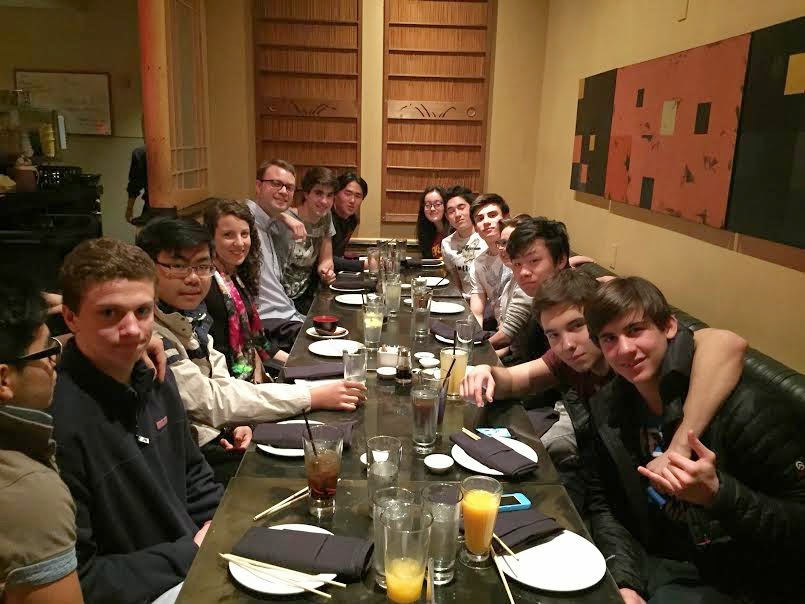
To end our stay in Seattle the group enjoyed a gourmet dinner at a brazilian steakhouse. We have enjoyed a great week in the Pacific Northwest but look forward to a return to Husky Nation with sustainable entrepreneurship on our minds!
Tuesday, March 10, 2015
Alchemy Goods, The Space Needle, and Chihuly Garden and Glass Museum
Today, our group traveled to Alchemy Goods, 10 minutes away from downtown Seattle. Alchemy Goods is a sustainable business that produces bags and accessories out of used bicycle tires and old truck tires.
The group took a tour around the factory and got a glimpse of how to run a sustainable business. Like any other sustainable business, the corporation focuses on reusing the unusable rather than looking for a larger profit.
After the tour the group took the monorail across the city to visit the Space Needle and the Chihuly Garden and Glass Museum.
The Space Needle sits 525 ft above Seattle and provides breathtaking 365 degree views of the city and mountains in the distance.
The Chihuly Garden and Glass Museum was truly unbelievable. Sculptures created by Dale Chihuly were on display, and everyone left in awe as you can see from the pictures yourself.
The group took a tour around the factory and got a glimpse of how to run a sustainable business. Like any other sustainable business, the corporation focuses on reusing the unusable rather than looking for a larger profit.

After the tour the group took the monorail across the city to visit the Space Needle and the Chihuly Garden and Glass Museum.
The Space Needle sits 525 ft above Seattle and provides breathtaking 365 degree views of the city and mountains in the distance.
The Chihuly Garden and Glass Museum was truly unbelievable. Sculptures created by Dale Chihuly were on display, and everyone left in awe as you can see from the pictures yourself.
Theo Chocolates and Chaco Cafe
Leaving school at 5:00 in the morning was tiring; the bus ride to Logan Airport was freezing; the six hours flight was not the greatest thing, but those concerns diminished when Seattle welcomed us with warm sunshine. With “Go Patriot” in mind, we started our first official day in Seattle.
After a breakfast at Seattle’s very own Starbucks, we went off to Theo Chocolate Factory for a sustainable tour. Theo Chocolate is the first organic and Fair Trade chocolate factory in the country with a founding principle that the finest artisan chocolate in the world can be produced in an entirely ethical and sustainable fashion.
Theo chocolate factory uses cacao beans from three organic farms from Panama, Congo and Peru. The factory tour guide specifically introduced the process of how to make cacao beans into chocolate for us. The factory only uses foods grown without synthetic pesticides or chemical fertilizer that do not contain genetically modified organisms (GMO's). The picture is only a couple bins full of cacao beans waiting to be roasted.
All the beans in the yellow bin would go into this giant machine to be fermented. Unlike coffee beans, cacao beans need more monitoring while roasting. The workers have to cut the beans open to see if the beans are ready to be in the next process of changing into a chocolate bar.
The beans in the red bins are already fermented and crushed into cacao nibs. They are ready to be put into the big green machine. The green machine is used to separate the cocoa butter from the cocoa solids. After about 12 hours of milling, mixing begins, and sugar is combined with cocoa liquor.
After tasting many different kinds of chocolate in the factory, we took a walk down Seattle’s streets before our sustainable meal in Chaco Canyon café.
Chaco Canyon Café provides a unique, environmentally conscious, and organic dining experience to the Seattle community. The café uses all sustainably produced, organic, eco-friendly, and local ingredients while balancing it with keeping the cost of food reasonable for the community. The manager later talked to the group about how the café was founded and why they decided to be organic. She mentioned in Seattle it is like “peer pressure” to be organic, since organic is everywhere.
After a short rest in the hotel, the group decided to visit downtown Seattle again. On our way to the waterfront, we saw a drummer on the street performing. Even Seattle’s drummer is sustainable!
Next to the waterfront, the view was breathtaking. Part of the group decided to go on a ferris wheel. On the ferris wheel, you get to see the view of the majority of downtown Seattle.
After a breakfast at Seattle’s very own Starbucks, we went off to Theo Chocolate Factory for a sustainable tour. Theo Chocolate is the first organic and Fair Trade chocolate factory in the country with a founding principle that the finest artisan chocolate in the world can be produced in an entirely ethical and sustainable fashion.
Theo chocolate factory uses cacao beans from three organic farms from Panama, Congo and Peru. The factory tour guide specifically introduced the process of how to make cacao beans into chocolate for us. The factory only uses foods grown without synthetic pesticides or chemical fertilizer that do not contain genetically modified organisms (GMO's). The picture is only a couple bins full of cacao beans waiting to be roasted.
All the beans in the yellow bin would go into this giant machine to be fermented. Unlike coffee beans, cacao beans need more monitoring while roasting. The workers have to cut the beans open to see if the beans are ready to be in the next process of changing into a chocolate bar.
The beans in the red bins are already fermented and crushed into cacao nibs. They are ready to be put into the big green machine. The green machine is used to separate the cocoa butter from the cocoa solids. After about 12 hours of milling, mixing begins, and sugar is combined with cocoa liquor.
After tasting many different kinds of chocolate in the factory, we took a walk down Seattle’s streets before our sustainable meal in Chaco Canyon café.
Chaco Canyon Café provides a unique, environmentally conscious, and organic dining experience to the Seattle community. The café uses all sustainably produced, organic, eco-friendly, and local ingredients while balancing it with keeping the cost of food reasonable for the community. The manager later talked to the group about how the café was founded and why they decided to be organic. She mentioned in Seattle it is like “peer pressure” to be organic, since organic is everywhere.
After a short rest in the hotel, the group decided to visit downtown Seattle again. On our way to the waterfront, we saw a drummer on the street performing. Even Seattle’s drummer is sustainable!
Next to the waterfront, the view was breathtaking. Part of the group decided to go on a ferris wheel. On the ferris wheel, you get to see the view of the majority of downtown Seattle.
A Day of Travel to Pike Place Market
After 2 hours on a frozen bus, 6 hours of relentless circus pranks on the plane, and one extra hour of hunting for vehicles, Sustainability in Seattle successfully arrived at their hotel in downtown Seattle.Despite the dreadful 3 hour jet-lag, the energetic group still insisted on going to one of the landmarks of this coastal city, Pike Place Market. It was a gorgeous day outside; the sun was shining and the temperature was in the mid to high 50’s.
The streets were filled with fresh produce, fresh seafood, bakeries, and artists selling their best works. It was pretty incredible to see all the different cultures blended together in one market. Students were able to enjoy Thai Food, Wood Fired Pizza, and authentic Greek Cuisine. Pike Place Market is also home to the original Starbucks, which will have to be visited on a day when the line doesn’t span around the street corner.
As for dinner, we went to a recommended asian restaurant named Dragonfish, in downtown Seattle. The dining experience was superb, the food was overwhelmingly palatable, and their sushi is strongly recommended for anyone who is interested in visiting. After we dined, we circled around the block near our hotel under the lead of Mr. C, who claimed that it was for the purpose of better digestion, and definitely not, because someone forgot that our hotel was right across the street from the restaurant. As soon as we returned from the walk, the seemingly energetic group finally agreed on going to bed early, and that pretty much concluded our 1st day of adventure.
(Photo credit: Dr.Woodard and Roderick Z.)
Subscribe to:
Posts (Atom)